

AI isn’t a reset. It’s the next leg of the data-driven journey you’ve been navigating for decades—and potentially the most consequential yet.
Most companies are already somewhere along that journey—from laptops and LANs to enterprise applications (ERP), business intelligence (BI), data warehousing (EDW), the Internet, e-commerce, CRM, mobile, social, and now AI. Each era has been built on the compounding evolution of the same fundamental elements: data + algorithms + integration + computing power.
That means the goal isn’t to throw out your digital playbook and start over. In most cases, it’s to augment or adapt the playbook and infrastructure you already have—identifying where AI can strengthen existing capabilities, reduce friction, and create new sources of economic value.
Technology has evolved dramatically, but the fundamental business imperative hasn’t: harness data and digital content to drive top-line growth, bottom-line efficiency, and sustainable ROI.
Many leadership challenges remain familiar as well: hype, uncertainty, investment pressure, organizational resistance, execution risk, and the fear of being left behind.
Across nearly three decades of leading businesses into the digital future, I (Craig) have seen the same pattern repeatedly: leaders recognize the significance of emerging technology but aren’t sure where to begin, struggle to translate strategy into execution, or fail to realize the business case.
I’ve also learned that the future becomes far less mysterious when you understand the past. Technologies change, but the patterns repeat.
At Sonic, we certainly experienced those patterns. In Bricks & Clicks, Cliff and I describe the difficult periods between strategy and successful execution as the “messy middles” – when the vision may be clear, but the path to realizing it rarely is.
AI Has Been Evolving for Decades
Artificial intelligence was not pioneered by Sam Altman and Elon Musk when they founded OpenAI in 2015. Its roots reach back to early computing and wartime cryptography, and AI emerged as a formal field of study at Dartmouth College in 1956. By 1986, it was part of my master’s program and thesis work.
Over the decades, AI quietly evolved through multiple approaches, including machine learning, adaptive algorithms, and statistical models that identify patterns within large datasets and use them to make predictions, generate insights, or inform and automate decisions.
Then came a powerful accelerant: the Internet.
It dramatically expanded the volume, diversity, and accessibility of digital data. Combined with rapidly increasing computing power and more sophisticated algorithms, AI began advancing at extraordinary speed.
For more than three decades, I’ve worked with early generations of AI-enabled technologies across multiple industries, military applications, and business functions – from predictive analytics, robotics, and threat detection to demand planning, supply chain optimization, suggestive selling, target marketing, and customer profiling.
The opportunity isn’t simply artificial intelligence replacing human intelligence. It’s augmented intelligence – AI amplifying human capability.
AI by Any Other Name
Long before ChatGPT and generative AI captured the headlines, earlier generations of AI and related technologies were already embedded in many of the systems and experiences we relied on every day.
Think about intelligent systems assisting pilots, driver-assistance, Alexa and Siri, recommendation engines, fraud detection, GPS navigation, or even autocorrect.
Businesses were doing the same thing.
Expert systems, predictive analytics, and machine learning have powered pricing, forecasting, personalization, supply chains, customer engagement, and decision support for decades.
Most companies simply didn’t call it AI. They called it revenue optimization, demand planning, risk management, customer profiling, or simply predictive analytics.
We experienced the same thing at Sonic. Years before today’s generative AI boom, we built the digital plumbing to leverage data, analytics, adaptive algorithms, and increasingly intelligent capabilities across suggestive selling, targeted marketing, inventory and labor management, supply chain optimization, loss prevention, CRM, and site selection.
Even then, AI wasn’t suddenly entering the enterprise. Earlier generations had already been there—often hiding in plain sight.
The Great Convergence: Why AI, Why Now?
So why does today feel different?
Three forces have converged:
- Digital density: Decades of investment extending connected technology throughout the operating models and customer journeys
- Data abundance: Businesses accumulating enormous amounts of transactional, behavioral, and operational data.
- Computing + algorithms: Advances in machine learning, cloud-based microservices, AI architectures (models), and computing horsepower.
Together, these forces created a tipping point: the ability to embed increasingly sophisticated intelligence across far more workflows, decisions, and customer interactions at scale.
AI didn’t suddenly emerge. It reached critical mass.
But perhaps the breakthrough that changed public perception wasn’t buried deep within the technology stack. It was the human interface.
ChatGPT put extraordinary computational complexity behind something everyone already understood: a conversation. Suddenly, everyday users could interact directly with remarkably sophisticated technology simply by typing into a box.
That breakthrough didn’t create the AI inflection point—it exposed it. Decades of technological evolution suddenly became visible and accessible, making an evolutionary journey feel like an overnight revolution.
AI moved from the lab to the mainstream-and then into the boardroom.
Stop Chasing AI. Start Creating Economic Value.
The question for executives is no longer whether AI matters, but where and how it can create measurable economic value.
Every operating model is built around processes, workflows, and decisions. Increasingly, intelligence can be embedded directly into each—using adaptive algorithms, machine learning, or generative models.
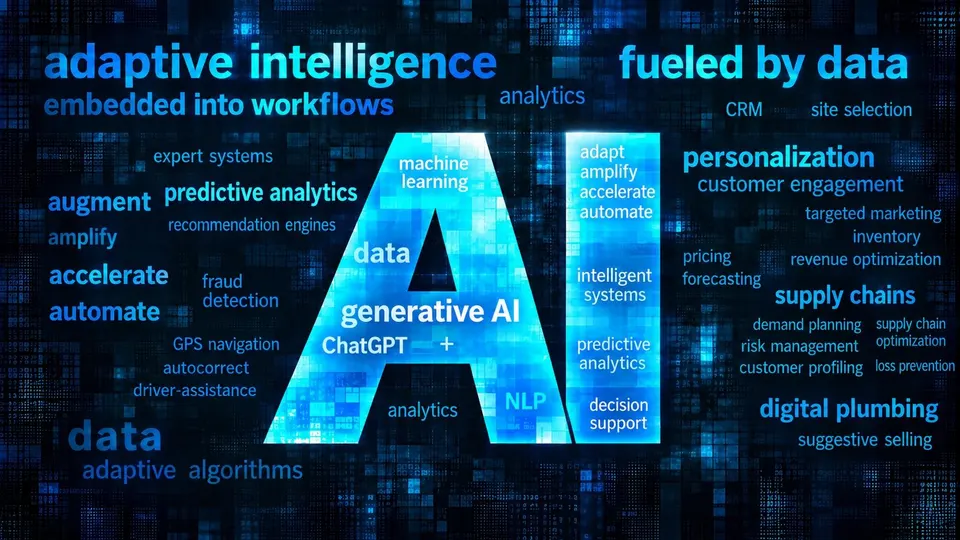
At its core, AI is adaptive intelligence – fueled by data – and embedded into workflows to augment, amplify, accelerate, and automate human and organizational capability.
The objective is to reduce friction across both the customer experience and operating model, accelerating decisions, improving engagement, increasing productivity, and strengthening execution. Ultimately, those improvements must translate into top-line growth, bottom-line efficiency, and sustainable ROI.
Too many companies make the mistake of approaching AI as another tool to deploy, platform to purchase, or technology to adopt. But AI creates economic value when it becomes embedded into the brand experience and how the business actually operates—not when it becomes another technology layer bolted onto the organization.
That was one of the central lessons of our journey at Sonic, which Cliff and I chronicle in Bricks & Clicks. Technology created value when it became woven into the customer experience, restaurant operations, brand marketing, menu innovation, decision-making, and economics of the business.
It reinforced one of the most consistent lessons of my career: recognizing the significance of a new technology is rarely the hardest part. The harder work is deciding where to begin, navigating the messy middle of execution, and ultimately proving the business case.
For leaders wondering where to begin, start with a disciplined 30-60-90 day sprint to turn ambition into action -aligning leadership, conducting a rigorous gap analysis, prioritizing the right opportunities, building the roadmap, instituting change management, and quickly begin proving measurable value.
The objective is not to boil the ocean. It is to start with focus, create momentum, prove the business case, and scale what works. Clarity creates focus. Focus creates action. Action creates results.
The latest wave of AI can predict demand, automate workflows, generate content, orchestrate operations, and continuously learn. The winners will be those who treat AI as an embedded business capability-connecting algorithmic intelligence directly to the customer experience, unit economics, innovation velocity, and brand differentiation.
The AI Value Equation
- Embedded Intelligence: Data + Models + Algorithms + Workflows
- Create Value: Augment + Amplify + Accelerate + Automate
- Reduce Friction: Customer Experience + Operating Model
- Deliver Economic Value: Top-Line Growth + Bottom-Line Efficiency + Sustainable ROI
The leadership challenge isn’t simply selecting the right AI technology. It’s identifying the right opportunities, mobilizing the organization, embedding intelligence into workflows, and converting those capabilities into measurable business outcomes.
AI is not the destination. Creating measurable economic value is.