

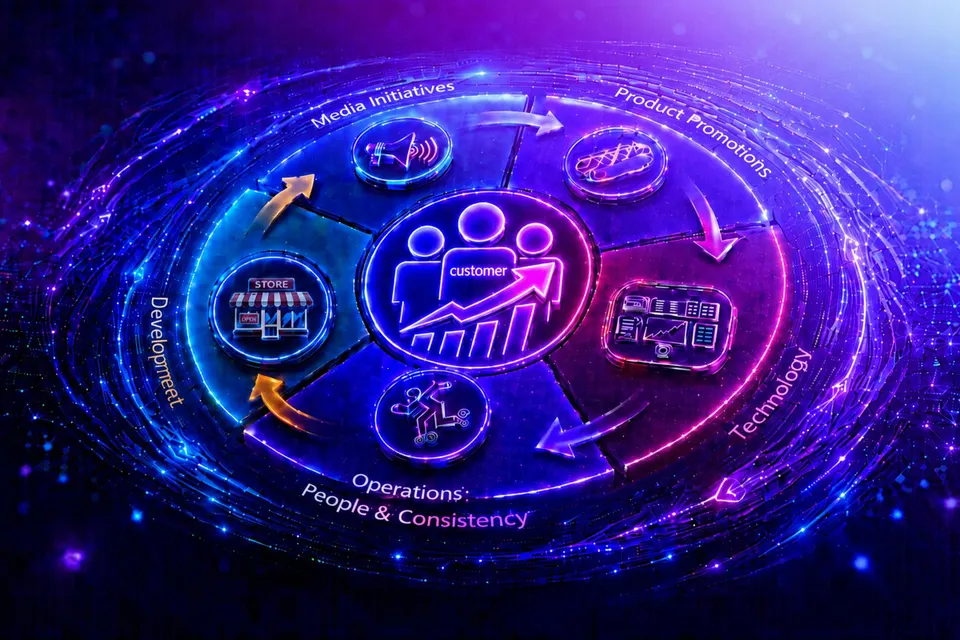
During my tenure as CEO at Sonic, spanning three decades of unprecedented change and opportunity, we experienced exponential growth by continually improving unit economics and expanding into new markets nationally, while most other drive-in brands vanished.
Our philosophy, courtesy of Thomas Edison, was simple: good fortune happens when opportunity meets preparation. That disciplined mindset allowed us to anticipate what was next, navigate unexpected obstacles, and keep our strategic flywheel churning to sustain the long-term momentum of our business – through every cycle, setback, and headwind in market conditions.
From doubling four decades of sales in four years, to multiple stock splits, to igniting our digital flywheel (spearheaded by our CIO, Craig), Sonic continued to build relentless momentum, propelling the company’s valuation and bringing a strategic acquirer (Roark) back three months after their original approach, with a 60+% premium to the time of that approach.
But regardless of the strategic imperatives that made Sonic a national treasure, they all began with what became our universal strategic framework, built on four primary disciplines: customer-focused, constant innovation, differentiated value proposition, and drive-in-level profitability.
Preserve the Core, Adapt to Endure
Changes facing companies today seem more radical and are happening faster than ever, fueled by rising Millennial and Gen Z/Alpha influence, a shifting competitive battlefield, and the accelerating evolution of technology, now entering the AI era.
Failing to prepare has always meant preparing to fail. But here’s the modern dilemma for leaders:
There is no crystal ball. Only perpetual uncertainty, accelerating change, and a business environment that feels increasingly volatile, chaotic, and unforgiving.
Yet somehow, some companies don’t just survive this turbulence – they thrive.
Walmart buried Kmart. Target displaced Sears. Best Buy outmaneuvered Circuit City. Chili’s roared ahead of rivals. Bank of America seized Merrill Lynch. Planet Fitness surged past Gold’s Gym.
But Sonic Drive-In represents a different kind of winner; it became a national icon while most other drive-in brands quietly disappeared.
Same markets. Similar resources. Radically different outcomes.
So, what separates the winners from the casualties?
It isn’t luck. It isn’t size. And it certainly isn’t technology alone.
The lesson is timeless: enduring success doesn’t belong to the largest, the oldest, or even the smartest. It belongs to those who anticipate change early, respond with discipline, and adapt continuously with the customer and the markets around them.
This is not about a one-time transformation. It’s about institutionalizing adaptability as a standard operating discipline that keeps the flywheel turning and sustains momentum.
Enduring companies are guided by core principles embedded in their DNA – shaped by foresight, reinforced by conviction, applied with flexibility, and translated into daily behaviors. They preserve their core value propositions while sustaining momentum, continuously adapting their strategic flywheels to changing market conditions.
At Sonic, these fundamental guiding principles were codified in a framework we called CuPID – a discipline designed to power our flywheel through:
- a constant focus on the Customer experience
- the rigor to ensure steady progress and ultimate Profitability
- persistence in seizing new opportunities to Innovate
- a clear sense of our Differentiation as a competitive advantage
- the ability to adapt to an ever-changing environment
In the fog of uncertainty, CuPID served as both barometer and strategic compass, helping our team anticipate change and recognize opportunities to sustain momentum and propel the brand to new levels every five years or so – from our national media launch and supply chain optimization to ice cream platform expansion, electronic payment innovation, and media mix reallocation.
Next Chapter: Winning the 21st Century Customer
By 2001, our flywheel was churning! System-wide sales went from $1 billion to $2 billion within 4 years, our stock split 3 times, and the value of our company had more than doubled. We produced more incremental annual system sales growth than the brand’s highest system annual sales in the preceding 40 years.
It was time for us to begin contemplating our next series of strategic growth initiatives to keep our flywheel spinning with the 21st-century customer.
As consumers’ shopping habits began shifting with the early adoption of electronic payment, email, and internet access, it was clear that technology and data could become a new source of energy fueling our momentum – deepening customer engagement, extending our differentiated service model, and accelerating in ways competitors would struggle to match.
That realization ignited the next chapter of our journey, one in which integrated technology and synthesized data, digital media, predictive algorithms, machine learning, and integrated customer engagement added new horsepower to Sonic’s virtuous flywheel – long before “CRM,” “omnichannel,” and “AI” became boardroom mandates in the restaurant industry.